
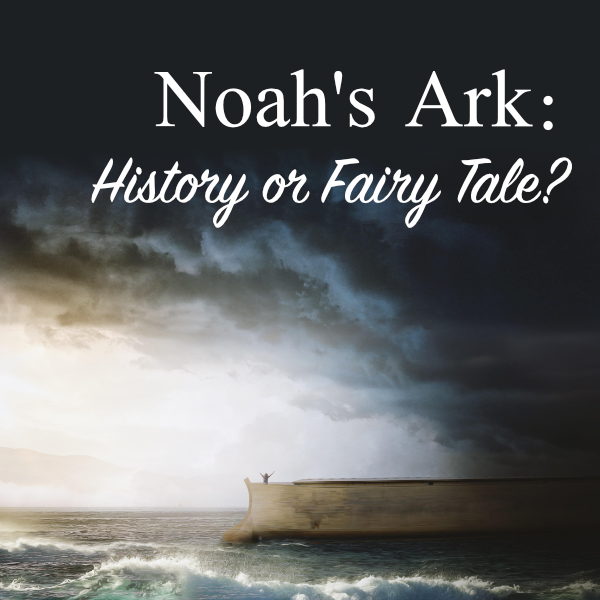
By faith Noah, being warned of God of things not seen as yet,
moved with fear, prepared an ark to the saving of his house;
by the which he condemned the world,
and became heir of the righteousness which is by faith.
Hebrews 11:7
Many centuries after Adam and Eve disobeyed God, bringing sin and death into the world, their descendants had grown so wicked and depraved, so rebellious toward God, that God announced judgement. He said that He would send a worldwide flood to destroy them. Only one righteous man found favor in the eyes of the Lord. His name was Noah. God told Noah to build an ark to save both him and his family, and representatives of all the land-dwelling, air-breathing animal kinds.
This is a well-known biblical account, but is it actually true? There are many who claim otherwise, stating that Noah couldn’t have built the ark, the animals wouldn’t fit inside, or even that Noah and his family could not have cared for that many animals on their own. In addition to these objections, many depictions of the ark show it as a small, cute, overcrowded boat, generally with giraffes poking their heads out somewhere. Is this just a nice story? Let’s take a closer look.
Building the Ark
How big was the ark? The Bible says it was 300 cubits long, 30 cubits high, and 50 cubits wide. There is some uncertainty about which of the possible ancient cubit lengths were used in the ark’s description, so we end up with a range, putting its length at 450 – 510 feet. The Bible also states it was to have three decks, and to be sealed inside and out with pitch. We don’t know all the details, but it certainly was a large vessel. But how could Noah and his three sons actually build something like this? First, the Bible seems to indicate they may have had 120 years between the announcement of the coming judgement and the flood itself (Genesis 6:3). Second, it is entirely possible that they could have hired others to help them with the construction, and from a biblical perspective, there is no reason to assume that people in Noah’s day were less intelligent or primitive. On the contrary, they may have been superior.
Did Noah Go on a Safari?
Some may wonder how Noah gathered all the animals from their various habitats around the world. Interestingly, in the creation account in Genesis 1, God commands the waters to be “gathered together into one place” (Genesis 1:9) when he formed the dry land. Could this imply that before the flood there was one landmass? There seems to be good evidence from geology that lines up with this. This would certainly simplify gathering the animals, but Noah didn’t have to go find them anyway. The Bible says God brought them.
How Many Animals?
This may well be the biggest question when it comes to Noah’s ark: How could all those animals fit? As we will see, the word “kind” is key. According to a report put out by the International Union for Conservation of Nature[i], there are 2,173,939 species that have been scientifically described. Of course, much of that number is comprised with microorganisms, various invertebrates, plants, and other organisms that wouldn’t be on the ark, since only “land-dwelling, air-breathing” animals were included. The number of vertebrate species, excluding fish, is 39,424 (this includes some marine animals such as whales and dolphins). However, this is still a very large number. Is this a problem?
“Two of Each Kind”
Remember that the Bible uses the word “kind.” It appears the word “kind” here refers most often to the family level of modern taxonomy, not the species or genus levels. For example, there wouldn’t be lots of different types of dogs on the ark, but two representatives of the dog kind. This lowers the total number of animals on the ark significantly! There has been a lot of research that has been done to determine how many animal kinds there were, with researchers from the ministry Answers in Genesis arriving at some very interesting numbers: Less than 1,400 animal kinds on the ark, translating to less than 7,000 individual animals.[ii] Based on the average size and space requirements and the biblical dimensions given for the ark, there was more than enough room to house the animals, supplies, and people on board.
What About Dinosaurs?
As land dwelling, air breathing animals, dinosaurs would have been included on the ark, too. Of course, this brings up an apparent problem: some dinosaurs were massive! Argentinosaurus, a long-necked dinosaur, has been estimated to get up to around 130 feet long. How would these enormous dinosaurs fit on the ark? Interestingly, dinosaur eggs are quite small. The biggest dinosaurs we know of appear to have had eggs around 6 inches in diameter. Even the largest dinosaurs started out small, and taking young, small dinosaurs on the ark answers this apparent problem.
That’s a Lot of Animals to Care For!
How could Noah and his family (eight people) care for several thousand animals? While it seems like an overwhelming task, it is possible with the right systems. Compare this to modern farmers who sometimes almost single-handedly care for thousands of animals, because they have the right systems and infrastructure in place.
Conclusion
There is much more that could be addressed about the flood and the ark, but I hope that what is covered here helps to show that when reading the Bible’s account of Noah’s ark, we are not reading fiction or allegory, but a true historical account. In the global, watery judgement of Noah’s time, the ark was the only way of salvation. Sometime, the earth will be judged again, and there is only one way of salvation. We all as sinners deserve eternal punishment and separation from God, but He provided a way for us to be redeemed through His Son, Jesus. Jesus came to this earth and died for us, rising again, so that if we repent of our sins and believe in Him, we can have eternal life with Him. Once again, God has provided us an “ark” of salvation. Have you climbed on board?
* * * * *
[i] International Union for Conservation of Nature: IUCN Red List version 2025-2: Table 1a. Last updated: 10 October 2025
[ii] Mike Belknap, Tim Chaffey, "Pocket Guide to Noah's Ark: A Biblical and Scientific Look at the Genesis Account" (Hebron, KY: Answers in Genesis-US, 2021) 52-53